
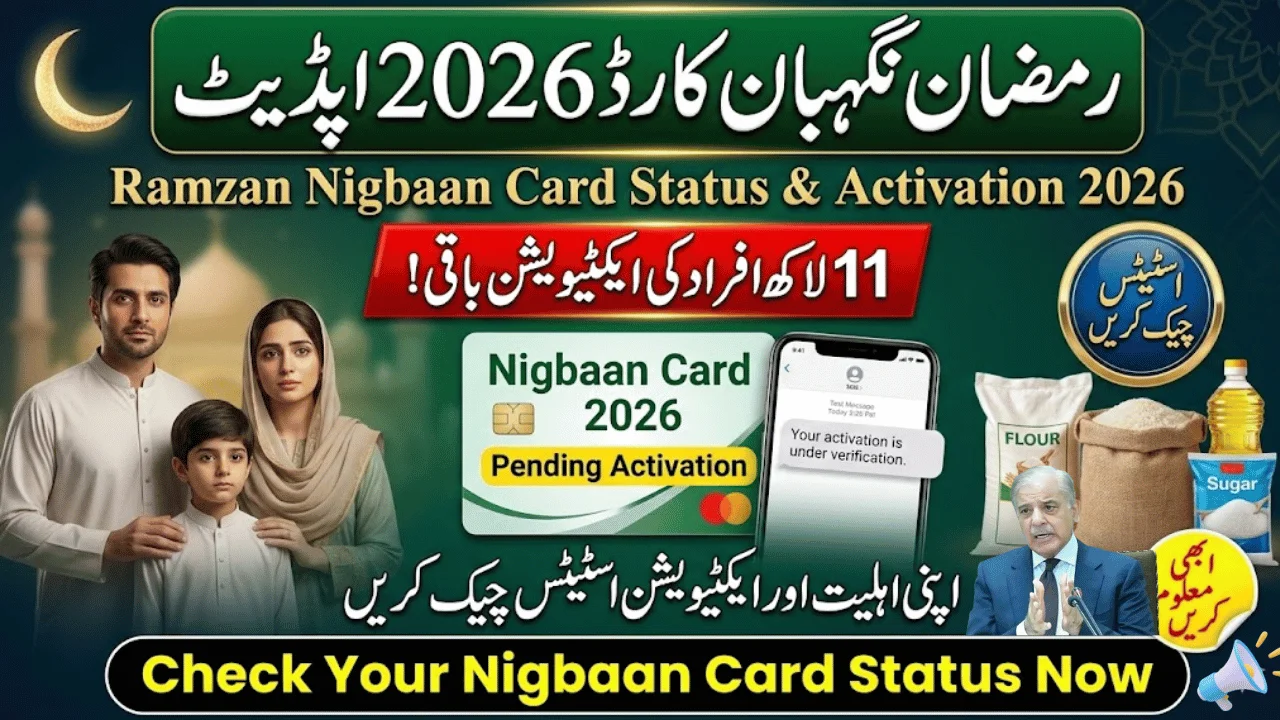
For thousands of low-income families, the Ramzan Nigbaan Card is not just a welfare card — it’s the difference between manageable grocery bills and overwhelming financial stress during Ramadan.
Yet many households are checking their phones daily, wondering why their card is still inactive. According to the latest 2026 updates, around 1.1 million beneficiaries have yet to complete activation or final transactions, even though millions have already received assistance.
If you’re among those waiting, this guide explains what’s happening behind the scenes, what delays actually mean, and what you should realistically expect next.
What Is the Ramzan Nigbaan Card?
The Ramzan Nigbaan Card is a targeted welfare initiative launched in Punjab to support economically vulnerable households with ration or financial assistance during Ramadan.
The program operates under the supervision of the Government of Punjab and relies heavily on the Punjab Socio-Economic Registry (PSER) database to determine eligibility.
Instead of distributing aid randomly, the system filters applicants using verified income data, household size, and poverty scores. That verification process is the key reason activation sometimes takes longer than expected.
Latest 2026 Activation Statistics
Based on official briefings and district-level updates:
| Category | Estimated Numbers (2026) |
|---|---|
| Beneficiaries who received assistance | 1.9 Million+ |
| Beneficiaries pending activation | 1.1 Million |
| Cards issued but not fully activated | Large portion of pending cases |
While 1.9 million successful disbursements reflect strong rollout progress, the remaining pending cases highlight the scale of the operation.
This is one of the largest Ramadan-focused welfare distributions in recent years.
Why Are 1.1 Million Cards Still Inactive?
If your status shows “pending” or your card isn’t activated yet, here are the most common reasons:
1. Fresh Survey Entries Require Extra Verification
Families recently added through PSER surveys must undergo full background verification. This includes:
-
Income assessment
-
Cross-checking existing welfare records
-
CNIC validation

-
Household data review
New entries often take longer because they are processed from scratch.
2. High System Load Across Districts
District and tehsil offices have seen heavy footfall. In some urban centers, thousands of applications are processed daily.
To avoid fraud and duplication, authorities are verifying records in phases rather than approving everyone at once.
3. Incomplete Transaction Steps
Some beneficiaries:
-
Received their card but didn’t complete biometric verification
-
Missed SMS notifications
-
Did not finalize required activation steps
Even a small delay in completing one step can temporarily pause activation.
Is the Delay a Sign of Rejection?
Not necessarily.
In most cases, “pending” simply means:
-
Your data is under review
-
Your case is scheduled for the next batch

-
Verification is incomplete
Rejections typically come with clear SMS notification.
Expected Timeline: When Will Pending Cards Be Activated?
Officials have indicated that:
-
Many pending cases will clear before or shortly after Eid
-
Newly surveyed families are likely to receive cards in the post-Eid distribution phase
-
SMS alerts will be sent automatically once activation is complete
Card printing and dispatch only begin after final approval — this is why some beneficiaries must wait for the next issuance cycle.
The Role of the Punjab Socio-Economic Registry (PSER)
The Punjab Socio-Economic Registry plays a central role in determining eligibility.
The registry evaluates:
-
Household income
-
Number of dependents
-
Employment status

-
Asset ownership
Why This Matters in 2026
With rising inflation, the province expanded survey coverage this year. That expansion brought in thousands of new applications — which increased processing time.
However, this also means newly struggling families now have a chance to qualify.
What Should Beneficiaries Do Now?
If your Ramzan Nigbaan Card is inactive, here’s practical advice:
✔ Keep Your Registered Phone Active
All communication is SMS-based.
✔ Avoid Repeated Unnecessary Visits
Frequent center visits rarely speed up processing.
✔ Ensure CNIC Is Valid
Expired CNICs can pause verification.
✔ Complete Biometric Verification Promptly
If called for biometric confirmation, complete it without delay.
Real-World Scenario
Consider a family surveyed just 10 days before Ramadan. Their data enters the system at the end of the verification cycle. While earlier applicants receive activation in the first batch, this family’s case shifts to the next processing phase.
They are still eligible — just queued for later activation.
This phased rollout prevents system overload and financial mismanagement.
Pros and Cons of the Current Activation Process
| Pros | Cons |
|---|---|
| Transparent eligibility filtering | Slower approval for new applicants |
| Reduced fraud risk | High demand causes delays |
| SMS-based communication | Confusion due to limited updates |
| Phased distribution ensures system stability | Requires patience from beneficiaries |
2026 Improvements in the Nigbaan Program
Compared to earlier welfare models, 2026 updates include:
-
Stronger digital cross-verification

-
Reduced manual paperwork
-
Expanded PSER coverage
-
District-level monitoring dashboards
-
More structured batch distribution
These improvements aim to balance transparency with speed.
FAQs – Ramzan Nigbaan Card Status & Activation
1. How do I check my Ramzan Nigbaan Card status?
Status updates are usually sent via SMS. If instructed, you may visit your local service center.
2. Why did my neighbor receive activation earlier than me?
Processing occurs in batches. Survey timing and data verification sequence affect approval order.
3. Can I speed up activation by visiting the office?
No. Activation depends on system verification, not manual requests.
4. Will newly surveyed families receive cards after Eid?
Yes, most late survey entries are expected to be included in post-Eid distribution.
5. What if my CNIC details are outdated?
You should update your information immediately, as mismatched records delay approval.
6. Is everyone guaranteed approval?
Only households meeting PSER eligibility criteria qualify.
Final Takeaway
The Ramzan Nigbaan Card status & activation delay affecting 1.1 million beneficiaries is largely due to phased verification and expanded survey coverage in 2026 — not cancellation.
If your status is pending, remain patient, keep your phone active, and ensure your documents are valid. The system is processing applications district by district to maintain fairness and transparency.
For many families, this support is essential. And while delays can be frustrating, structured verification ensures that assistance reaches the truly deserving households — not just the fastest applicants.