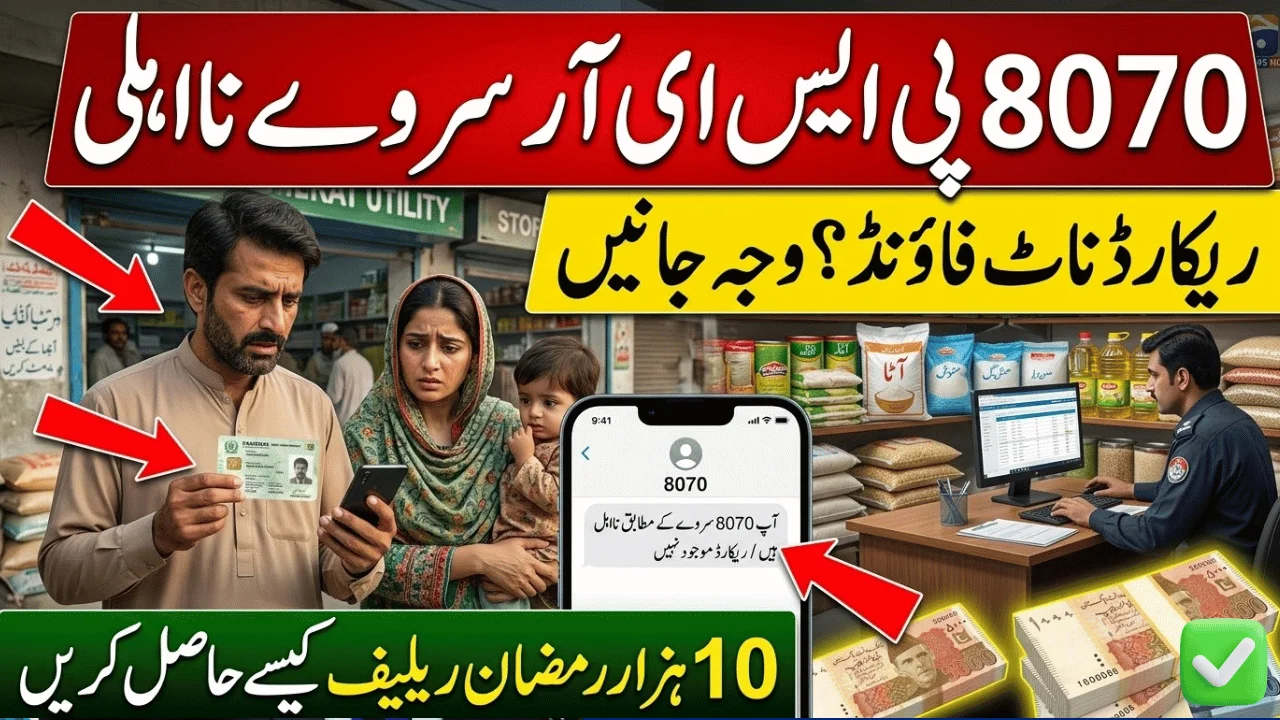
Many families in Punjab are relying on government assistance programs to manage rising living costs during Ramadan. The 8070 Ramzan Relief Program 2026 was introduced to support low-income households with Rs. 10,000 financial aid and essential ration items. However, thousands of applicants are receiving unexpected responses such as “Ineligible” or “Record Not Found” after sending their CNIC to 8070.
For families already struggling with food prices and household expenses, this rejection can be frustrating. The good news is that in many cases the issue is not permanent. Most ineligibility problems happen because of incorrect data in the Punjab Socio-Economic Registry (PSER) or outdated records in government databases.
This guide explains the real reasons people are rejected under the 8070 PSER Survey Ineligibility Criteria, how the verification system works, and what practical steps you can take to correct your information and reapply successfully.
What Is the 8070 Ramzan Relief Program 2026?
The 8070 Ramzan Relief Program is a welfare initiative launched by the Punjab government to help low-income families manage food expenses during Ramadan.
Instead of relying only on traditional ration distribution, the program combines cash support with essential food packages.
Program Overview
| Feature | Details |
|---|---|
| Program Name | 8070 Ramzan Relief Program 2026 |
| Cash Assistance | Rs. 10,000 |
| Additional Support | Free ration items |
| Eligibility Check | Send CNIC to 8070 |
| Data Verification | PSER (Punjab Socio-Economic Registry) |
| Official Portal | pser.punjab.gov.pk |
The system uses digital verification to ensure that government support reaches genuinely deserving households.
Why Many Families Receive “Ineligible” Messages from 8070
Receiving an 8070 PSER Survey Ineligibility message does not always mean you are permanently disqualified. In many cases, the system simply detects information that suggests your household income or assets exceed the eligibility threshold.
Because the system automatically checks several government databases, even small record errors can trigger rejection.
Common Reasons Applicants Become Ineligible
| Reason | Explanation |
|---|---|
| High Poverty Score (PMT) | System believes your household income is above the threshold |
| Government Job | Applicant or spouse works in government sector |
| Vehicle Ownership | Car or tractor registered under CNIC |
| Already Receiving Aid | Existing benefits from other major welfare programs |
| Non-Punjab Resident | Address not registered in Punjab |
| High Utility Bills | Electricity or gas bills above eligibility limits |
Understanding the exact reason behind rejection is the first step toward fixing the problem.
PMT Score – The Most Important Eligibility Factor
The Poverty Means Test (PMT) score is one of the most critical elements used in PSER verification.
This score is calculated based on:
-
Household income
-
Property ownership
-
Family size
-
Utility usage
-
Employment status
If your PMT score is above the required limit, the system will automatically mark your application as ineligible.
Why Some Low-Income Families Still Get High PMT Scores
Many families are surprised to learn their PMT score is too high. This usually happens due to outdated or incomplete data.
For example:

-
Family members missing from the PSER survey
-
Old property records still linked to your CNIC
-
Utility bills that reflect multiple households on one meter
-
Incorrect housing status (owned vs rented)
Updating these records can often reduce the PMT score and restore eligibility.
Income Above Rs. 60,000 Limit
One of the key 8070 PSER Survey Ineligibility Criteria is household income.
Families earning more than Rs. 60,000 per month are generally excluded from the program.
However, mistakes sometimes happen when income data is incorrectly recorded.
Income Status and Eligibility
| Income Level | Eligibility |
|---|---|
| Below Rs. 60,000 | Usually eligible |
| Above Rs. 60,000 | Ineligible |
| Income Not Verified | Under review |
How to Correct Income Errors
If the system shows incorrect income data, you can:
-
Submit salary slips or employment proof
-
Provide an income affidavit if self-employed
-
Update household income details on the PSER portal
-
Request manual verification from local authorities
Accurate income reporting helps prevent unnecessary rejection.
Vehicle or Property Ownership Issues
Another major reason people fail the 8070 PSER eligibility check is asset ownership.
Even an old or unused vehicle registered under your CNIC can increase your poverty score.
Assets That May Affect Eligibility
-
Cars or tractors registered under your name
-
Agricultural land ownership

-
Urban property ownership
-
Commercial property records
What You Can Do
If the vehicle or property does not truly belong to you anymore:
-
Verify ownership at the Excise and Taxation Department.
-
Transfer the asset legally if it has been sold.
-
Submit updated ownership documents to PSER.
Correcting these records may improve your eligibility status.
CNIC and NADRA Record Problems
Identity verification errors are surprisingly common in welfare programs.
Even small mismatches between NADRA records and PSER data can cause eligibility problems.
Common CNIC Issues
-
Name spelling differences
-
Incorrect family relationships
-
Expired CNIC
-
SIM card not registered under your CNIC
Steps to Fix CNIC Problems
-
Visit a NADRA office for corrections.
-
Update family information in the NADRA database.
-
Register your SIM card in your own name.
-
Update your PSER profile after correction.
Once the systems synchronize, eligibility checks usually work correctly.

Utility Bills Can Affect Your Eligibility
Electricity and gas bills are also used to estimate household income.
If your monthly electricity bill is unusually high, the system may assume your household has a higher financial capacity.
Problems That Raise Utility-Based PMT Score
-
Shared electricity meters
-
Commercial usage linked to home meter
-
Incorrect billing category
How to Correct Shared Meter Problems
If multiple families use the same meter:
-
Mention shared connection during PSER survey
-
Provide documentation from electricity department
-
Upload rental agreements if living in rented property
These steps help prevent inflated household income estimates.
Step-by-Step Method to Fix 8070 PSER Ineligibility
If you received an ineligible message, follow this practical correction process.
Step 1 – Check Your PSER Profile
Visit the official portal and log in using your CNIC.
Step 2 – Identify the Rejection Reason
Look for the specific issue mentioned in your application status.
Step 3 – Update Incorrect Information
Edit household details, income records, and asset information.
Step 4 – Upload Supporting Documents
Submit documents such as:
-
Salary proof
-
Property documents
-
Utility records

Step 5 – Request Re-Verification
Submit the application for re-evaluation.
Step 6 – Visit Local Authorities if Needed
If the issue cannot be resolved online, visit the nearest PSER office or Assistant Commissioner office.
Pros and Limitations of the 8070 PSER Verification System
Advantages
-
Transparent eligibility process
-
Digital verification reduces fraud
-
Faster identification of deserving households
-
Online correction options available
Limitations
-
Errors in government records can affect eligibility
-
Internet access required for online updates
-
Data synchronization delays may occur
Despite these challenges, the system is designed to improve fairness in welfare distribution.
Frequently Asked Questions (FAQs)
What does “8070 PSER Survey Ineligibility Criteria” mean?
It means the system determined that your household does not currently meet the eligibility requirements for the Ramzan Relief Program.
Can I apply again after being rejected?
Yes. If the rejection happened due to incorrect information, you can update your data and request re-verification.
How do I check my eligibility for the Ramzan Relief Program?
Send your CNIC number to 8070 or check your status through the official PSER portal.
What is the PMT score?
The Poverty Means Test score measures a household’s financial condition based on assets, income, and living conditions.
Can shared electricity meters cause rejection?
Yes. Shared meters can increase the calculated household income unless correctly reported during registration.
Conclusion
The 8070 PSER Survey Ineligibility Criteria can be confusing for many families who genuinely need support during Ramadan. However, rejection messages often occur because of outdated records, incorrect income details, or asset data errors rather than actual ineligibility.
By carefully reviewing your PSER profile, correcting household information, and submitting accurate documents, many applicants can successfully resolve their eligibility problems.
Government assistance programs are designed to support deserving families, but accurate data is essential for fair distribution. Taking the time to update your records can help ensure that your household receives the relief it needs during Ramadan.