Many families across Punjab rely on government welfare programs to manage essential expenses, especially during Ramadan when food and household costs often increase. However, one of the biggest challenges people face when applying for relief programs is understanding whether they actually qualify.
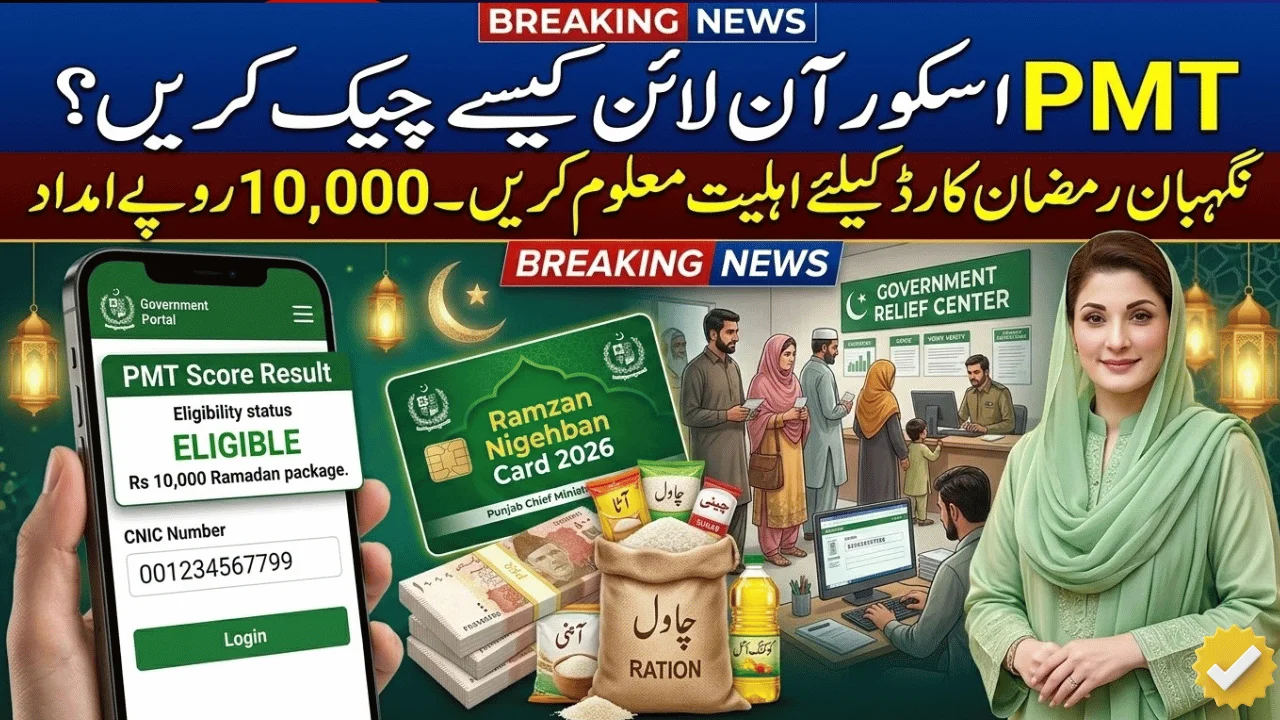
This is where the PMT score (Poverty Means Test) becomes important. The PMT score is a key factor used by government welfare systems to determine which households are financially eligible for assistance such as the Nigehban Ramzan Card and the Rs. 10,000 Ramadan support program.
If you are planning to apply for financial assistance in 2026, checking your PMT score online is one of the first and most important steps. This guide explains what the PMT score means, how it is calculated, how to check it online, and what you can do if your score is incorrect.
What Is a PMT Score and Why It Matters
The PMT (Poverty Means Test) score is a numerical value assigned to a household based on its financial condition. Government welfare systems use this score to measure economic vulnerability and decide who should receive social support.
Instead of relying only on income declarations, the PMT system analyzes multiple factors to determine a family’s financial situation.
Factors Considered in PMT Score Calculation
The score usually reflects several socio-economic indicators, including:
-
Household income
-
Number of family members
-
Employment status
-
Type of housing
-
Ownership of vehicles or land
-
Access to utilities
-
Education level of household members
For example, a family living in a rented house with a single earner and several dependents will usually receive a lower PMT score, indicating greater financial need.
On the other hand, a household with multiple earners and valuable assets may receive a higher PMT score, which reduces eligibility for certain welfare programs.
Why PMT Score Is Important for the Nigehban Ramzan Card
Government relief programs must ensure that assistance reaches the families who need it most. The PMT score helps achieve this by prioritizing households facing the greatest economic challenges.
For programs like the Nigehban Ramzan Card, the PMT score determines:
-
Whether a household qualifies for financial assistance
-
Priority level in welfare distribution
-
Eligibility for the Rs. 10,000 Ramadan support package
In simple terms, a lower PMT score increases the chances of receiving support, while a higher score may place the household outside the eligibility threshold.
How to Check Your PMT Score Online in 2026
The government has simplified the process of checking PMT scores by allowing citizens to verify their information online.
Step-by-Step Process
-
Visit the official government welfare portal.
-
Enter your 13-digit CNIC number without dashes.
-
Complete the verification captcha.
-
Submit the request to check your PMT score.
-
The system will display your score and eligibility information.
It is recommended to take a screenshot or save the result for future reference when applying for welfare programs.
Understanding PMT Score Ranges
Different score ranges indicate different levels of financial vulnerability. Although eligibility rules may vary slightly between programs, the following table provides a general understanding.

| PMT Score Range | Financial Condition | Eligibility Chances |
|---|---|---|
| 0 – 30 | Extremely low income | Very high eligibility |
| 31 – 50 | Low income | High eligibility |
| 51 – 70 | Moderate income | Possible in limited cases |
| Above 70 | Stable income | Usually not eligible |
For example:
-
A household with a PMT score of 25 is highly likely to qualify for assistance.
-
A score around 45 still indicates financial vulnerability.
-
Scores above 70 usually indicate that the household is financially stable enough not to require assistance.
Real-World Example of How PMT Score Works
To better understand how the PMT system works, consider two different families:
Example 1: Low-Income Household
A family of six lives in a rented house. The father works as a daily wage laborer and income fluctuates every month.
Possible PMT score: Below 30
Result: High probability of qualifying for government relief programs.
Example 2: Middle-Income Household
A family owns a house, two members are employed, and the household owns a vehicle.
Possible PMT score: Above 60
Result: Lower priority or ineligible for certain relief programs.
These examples demonstrate how the PMT score helps authorities allocate resources fairly.
Common Mistakes People Make When Checking PMT Scores
Many applicants encounter problems simply because of small mistakes during the verification process.
Frequent Issues
-
Entering an incorrect CNIC number
-
Using unofficial websites or fake portals
-
Ignoring captcha verification
-
Not completing the household survey
-
Assuming eligibility without checking the score

To avoid these problems, always use official government portals and ensure your information is accurate.
How to Improve Data Accuracy in the PMT System
While individuals cannot directly change their PMT score, they can ensure that their household information is correctly recorded.
Practical Steps
-
Update your CNIC details with NADRA if necessary.
-
Ensure your household survey information is correct.
-
Report incorrect data at local government offices.
-
Inform authorities if your financial situation has changed significantly.
Accurate data ensures the PMT system reflects your true economic situation.
Advantages and Limitations of the PMT System
Benefits
-
Fair distribution of welfare funds
-
Reduces fraud in government programs
-
Uses multiple indicators instead of income alone
-
Helps prioritize the most vulnerable households
Limitations
-
Some households may have outdated data
-
Sudden financial crises may not immediately reflect in the score
-
Rural data collection may occasionally be incomplete
Despite these limitations, the PMT system remains one of the most effective tools for targeting welfare programs.
Frequently Asked Questions (FAQs)
What does PMT stand for?
PMT stands for Poverty Means Test, a scoring system used to evaluate a household’s economic condition.
Is checking PMT score necessary before applying for the Nigehban Ramzan Card?
Yes. Checking your PMT score helps determine whether you are likely to qualify for the program before submitting an application.
Can my PMT score change over time?
Yes. If your household income, employment status, or family size changes, your PMT score may be recalculated in future surveys.
What should I do if my PMT score seems incorrect?
You can visit your local government office or survey center to update your household information.
Is there any fee for checking the PMT score online?
No. Checking your PMT score through official government portals is completely free.
Final Thoughts
The PMT score plays a critical role in ensuring that government relief programs reach families who truly need assistance. By analyzing household economic conditions, the system helps authorities distribute welfare funds fairly and transparently.
For anyone planning to apply for programs such as the Nigehban Ramzan Card or other financial assistance initiatives, checking the PMT score online is a smart first step. It provides clarity about eligibility and helps applicants avoid unnecessary delays.
Keeping your household information accurate and up-to-date will not only improve the reliability of your PMT score but also increase your chances of receiving support when it matters most.
Latest Updates