
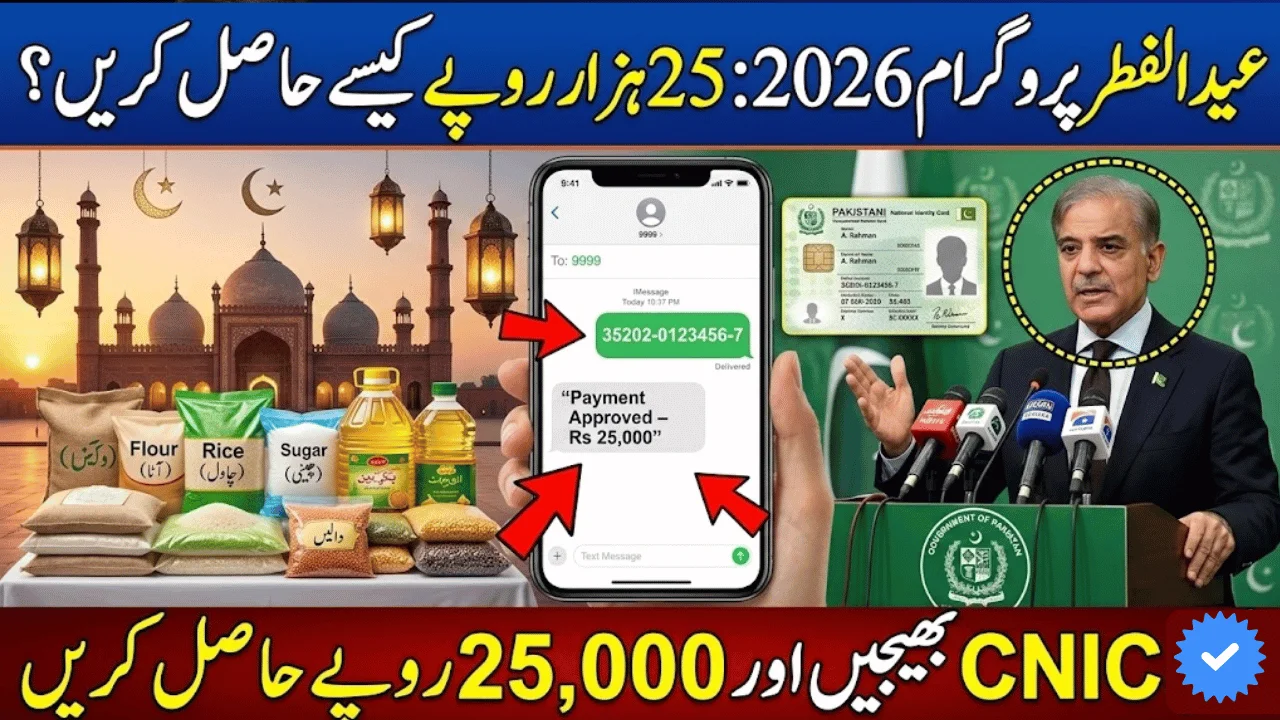
For many families in Pakistan, Ramadan and Eid are times of spiritual joy—but they also bring financial pressure. Grocery prices often rise during Ramadan, and preparing for Eid can become challenging for households already struggling with inflation, utility bills, and everyday expenses.
To address this issue, the government has introduced the Eid Ul Fitr Program 25000 under the Ramzan Package 2026, designed to provide financial assistance and essential support to low-income families across Pakistan.
Through this initiative, eligible households may receive up to Rs. 25,000 in financial assistance, along with additional support such as subsidized food items and relief on utility expenses.
This guide explains how the program works, who qualifies, how to apply using CNIC, and practical tips to ensure your application is successful.
What Is the Eid Ul Fitr Program 25000?
The Eid Ul Fitr Program 25000 is a special relief initiative linked to the broader Ramzan Package 2026, aimed at helping financially vulnerable families manage Ramadan and Eid expenses.
Instead of relying only on discounted grocery items, the program combines several types of support to ensure families can celebrate Eid without severe financial stress.
Main Purpose of the Program
The government designed the program to address multiple household needs:
-
Provide direct financial assistance to deserving families
-
Ensure access to subsidized food items during Ramadan
-
Reduce financial burden through utility bill relief for low-income users
-
Help families prepare for Eid celebrations with dignity
By combining cash assistance with food subsidies, the program attempts to create a more holistic relief system.
Key Benefits of the Ramzan Package 2026
The relief initiative includes several types of support aimed at improving household financial stability during Ramadan.
Major Components of the Program
| Benefit | Description |
|---|---|
| Direct Cash Support | Eligible families may receive up to Rs. 25,000 |
| Subsidized Grocery Items | Discounts on flour, sugar, pulses, and cooking oil |
| Utility Relief | Reduced electricity or gas bills for low consumption households |
| Provincial Assistance | Additional relief programs introduced by provinces |
These benefits aim to support families in both daily food needs and festival-related expenses.
Who Is Eligible for the Eid Ul Fitr Program 25000?
Eligibility is determined through government welfare databases, primarily the National Socio-Economic Registry (NSER).
The system evaluates household income and financial conditions before approving applicants.
Basic Eligibility Requirements
| Requirement | Details |
|---|---|
| CNIC | Must have a valid NADRA-issued CNIC |
| Income Level | Household must belong to a low-income category |
| Poverty Score | PMT score should fall within the eligible range |
| Employment Status | Government employees with stable income may not qualify |
| Database Verification | Household information must match government records |
The system automatically checks your data through national welfare databases.

Understanding the PMT Score in Simple Terms
A Poverty Means Test (PMT) score is used by government programs to identify households facing financial hardship.
It evaluates factors such as:
-
Household income level
-
Type of housing
-
Number of dependents
-
Employment status
-
Access to basic utilities
A lower PMT score generally indicates higher financial vulnerability, increasing the likelihood of eligibility for relief programs.
How to Apply for Eid Ul Fitr Program 25000
The government has made the registration process simple so that citizens can apply without complicated paperwork.
Method 1: Apply Through SMS (9999 Code)
This method is the easiest for people who do not have internet access.
Steps to apply:
-
Open the SMS application on your mobile phone
-
Type your 13-digit CNIC number without spaces or dashes
-
Send the message to 9999
-
Wait for an SMS reply confirming your eligibility status
The response message will usually indicate one of the following:

-
Eligible
-
Under verification
-
Not eligible
Method 2: Apply Through Online Portal
If you have internet access, you can also check eligibility through the official government portal.
Online application process:
-
Visit the official relief program website
-
Enter your CNIC number
-
Complete captcha verification
-
Submit your details
-
Check eligibility and payment updates
Online verification often provides more detailed status information.
Special Support for Punjab Applicants
Residents of Punjab may receive additional assistance through provincial programs that complement the federal Ramzan package.
Examples include:
-
Ration distribution programs
-
Food subsidy schemes
-
Additional provincial relief initiatives

In some areas, authorities may also organize door-to-door distribution of ration packages for registered families.
Payment Distribution Methods
Once eligibility is confirmed, beneficiaries can receive financial assistance through different channels.
Possible Payment Options
| Method | Description |
|---|---|
| Mobile Wallets | Transfer through Easypaisa or JazzCash |
| Bank Accounts | Direct transfer to CNIC-linked accounts |
| Government Distribution Centers | Payment collection at authorized locations |
| Welfare Program Offices | Available for registered beneficiaries |
Applicants usually receive SMS instructions explaining how and where to collect their payment.
Common Mistakes That Can Delay Approval
Many applications face delays due to avoidable errors.
Incorrect CNIC Entry
Typing spaces or dashes in the CNIC number may cause the SMS system to reject the request.
Expired Identity Card
An expired CNIC can prevent the system from confirming eligibility.
SIM Not Registered in Applicant’s Name
Using someone else’s SIM card may cause verification issues.
Duplicate Applications
Submitting multiple applications from the same household can trigger automatic rejection.
Safety Tips to Avoid Fraud
Unfortunately, welfare programs often attract scammers trying to exploit applicants.
To protect yourself:
-
Only use official government websites ending in
.gov.pk -
Never share your OTP, PIN, or bank details
-
Ignore anyone asking for registration fees
-
Trust only SMS messages from official codes like 9999 or 8171
Remember: government relief programs are completely free.
Pros and Cons of the Eid Ul Fitr Relief Program
Advantages
-
Helps families manage Ramadan and Eid expenses

-
Direct financial assistance improves flexibility
-
Digital verification reduces corruption
-
Accessible registration through SMS
Limitations
-
Some deserving families may not appear in welfare databases
-
Verification may take time during peak demand
-
Network congestion can delay SMS responses
Despite these limitations, the program remains an important step toward financial inclusion and social protection.
Frequently Asked Questions (FAQs)
How much financial assistance does the Eid Ul Fitr Program provide?
Eligible families may receive up to Rs. 25,000, depending on eligibility verification.
Is registration for the program free?
Yes. There is no fee for registration or eligibility checks.
How long does the eligibility verification take?
Verification may take 24–72 hours, depending on database checks.
Can I apply if I already receive another welfare benefit?
In many cases yes, but eligibility depends on government database verification.
What should I do if my status shows “under verification”?
Wait for the final confirmation message. Authorities may still be reviewing your records.
Final Thoughts
The Eid Ul Fitr Program 25000 under Ramzan Package 2026 is designed to help families cope with rising living costs during Ramadan and prepare for Eid with dignity. By combining direct financial support, food subsidies, and utility relief, the program aims to provide meaningful assistance to those who need it most.
For applicants, the best approach is to register using official channels, ensure your CNIC details are accurate, and avoid unofficial agents or websites.
With proper verification and timely registration, eligible families can benefit from this relief initiative and celebrate Eid with greater financial security.